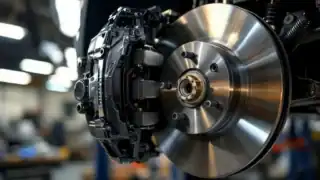
When your Audi’s brakes start to feel soft, take longer to stop, or make noise, you need a specialist who understands how Audi brake systems work. An Audi Brake Specialist in Northmead can diagnose the real problem and get your car stopping safely again. Brakes are safety-critical, and waiting for symptoms to get worse puts you and your passengers at risk. We inspect Audi brake systems regularly and know exactly what to look for across A3, A4, A6, and Q5 models.
What are the warning signs your Audi needs brake work?
Brake issues rarely announce themselves quietly. If you notice any of these symptoms, book a brake inspection before the problem gets worse.
- Soft or spongy brake pedal that sinks toward the floor when you press it
- Brake pedal that feels harder to press than usual, even with gentle pressure
- Squealing or squeaking noise when braking, especially when the car is cold
- Grinding sound during braking, which signals worn pads grinding against the rotor
- Brake warning light on the dashboard (check your Audi’s instrument cluster)
- Longer stopping distances than normal, even with full pressure on the pedal
- Vibration or pulsing through the pedal when braking
- Uneven brake wear, where one wheel stops harder than the other
Any of these warrant a professional inspection. Brake fluid leaks, worn pads, warped rotors, and faulty calipers all behave differently, and diagnosing correctly from the start saves you money and keeps you safe.
How we inspect and service Audi brakes in Northmead
Our brake diagnostic process for Audi vehicles follows manufacturer specifications and goes deeper than a quick visual check. We use Audi-specific diagnostic tools to read fault codes from the brake control module, which catches electrical issues and ABS faults that a basic inspection would miss.
Here’s what a full Audi brake inspection includes:
- Brake pad thickness measurement on all four wheels, compared against Audi’s wear limits
- Rotor condition assessment: checking for scoring, warping, and thickness variation with a calliper
- Caliper function test to ensure pistons move freely and pads contact evenly
- Brake fluid condition and level check; Audi systems require DOT 4 fluid with specific hygroscopic properties
- Hose inspection for splits, cracks, or swelling that indicate age or contamination
- ABS and electronic brake distribution system diagnosis using Audi’s fault code reader
- Brake line inspection for corrosion or damage
- Test drive to feel for pedal response, pulling, noise, and stopping power
Once we’ve identified the issue, we explain exactly what you’re looking at: whether pads are simply worn and rotors are still good, or whether rotors need machining or replacement. Audi brake systems use both OEM rotors and quality aftermarket equivalents; we’ll discuss your options before work starts.
What affects brake repair time and cost for your Audi
Brake work is rarely a one-size-fits-all job. Several factors influence how long the repair takes and what parts you’ll need.
Parts availability: Genuine Audi brake pads and rotors ship reliably, but we also fit quality aftermarket parts where they meet OEM specifications. Sometimes a rotor needs turning rather than replacement, which is quicker and cheaper. Other times both pads and rotors must be replaced together for balanced braking.
Severity of wear: Pad replacement alone is straightforward. If rotors are scored or warped, or if calipers aren’t moving freely, the job expands. A single seized caliper can take hours to free up.
Audi model: Brake systems differ between A3, A4, A6, and Q models. Larger vehicles carry heavier brake loads and sometimes use different pad compounds. We factor this into the diagnostic.
Fluid condition: If brake fluid is contaminated or brake lines are corroded, a full fluid flush and line replacement might be necessary. This protects long-term brake reliability but adds time.
We never estimate brake costs over the phone. A proper inspection tells us exactly what’s needed, and we’ll explain the options before you commit. You’ll know what the job involves and what parts we’re using before work begins.
Why choose an Audi brake specialist for your vehicle
Audi brake systems are engineered precision work. They’re not mysterious, but they do demand the right diagnostic approach and parts knowledge. We specialise in European vehicles, including Audi, BMW, Mercedes, and Volkswagen, which means we see Audi brake patterns and failure modes regularly. We know which models tend toward rotor distortion, which calipers stick, and how Audi’s electronic brake systems respond to faults.
Owner Sarkis has been a mechanic for over a decade, with hands-on experience across timing chains, transmissions, and brake systems. That expertise means we don’t guess at diagnostics. We read the codes, inspect the components, and explain what we find in plain language.
You won’t be pressured into work you don’t need. We’ll tell you if brake pads have another 10,000 km of life left. We’ll explain the trade-off between genuine Audi parts and quality aftermarket alternatives. If your brakes are safe and your warning light is a sensor malfunction, that’s what we’ll say. That transparent approach is why customers return and trust us with their Audis.
We also fit quality parts with manufacturer warranty, so your brake work is backed by parts reliability, not just our labour. Star Mechanical Repairs has serviced the Northmead community with honest, no-pressure repairs across European makes for years.
Get your Audi brake system inspected
If your Audi is making noise, feeling soft, or showing warning lights, don’t delay. Brake safety isn’t something to test or hope improves on its own. Book Your Free Inspection with us in Northmead, or Call Us Now to speak directly with our team. We’re ready to get your Audi stopping safely again.